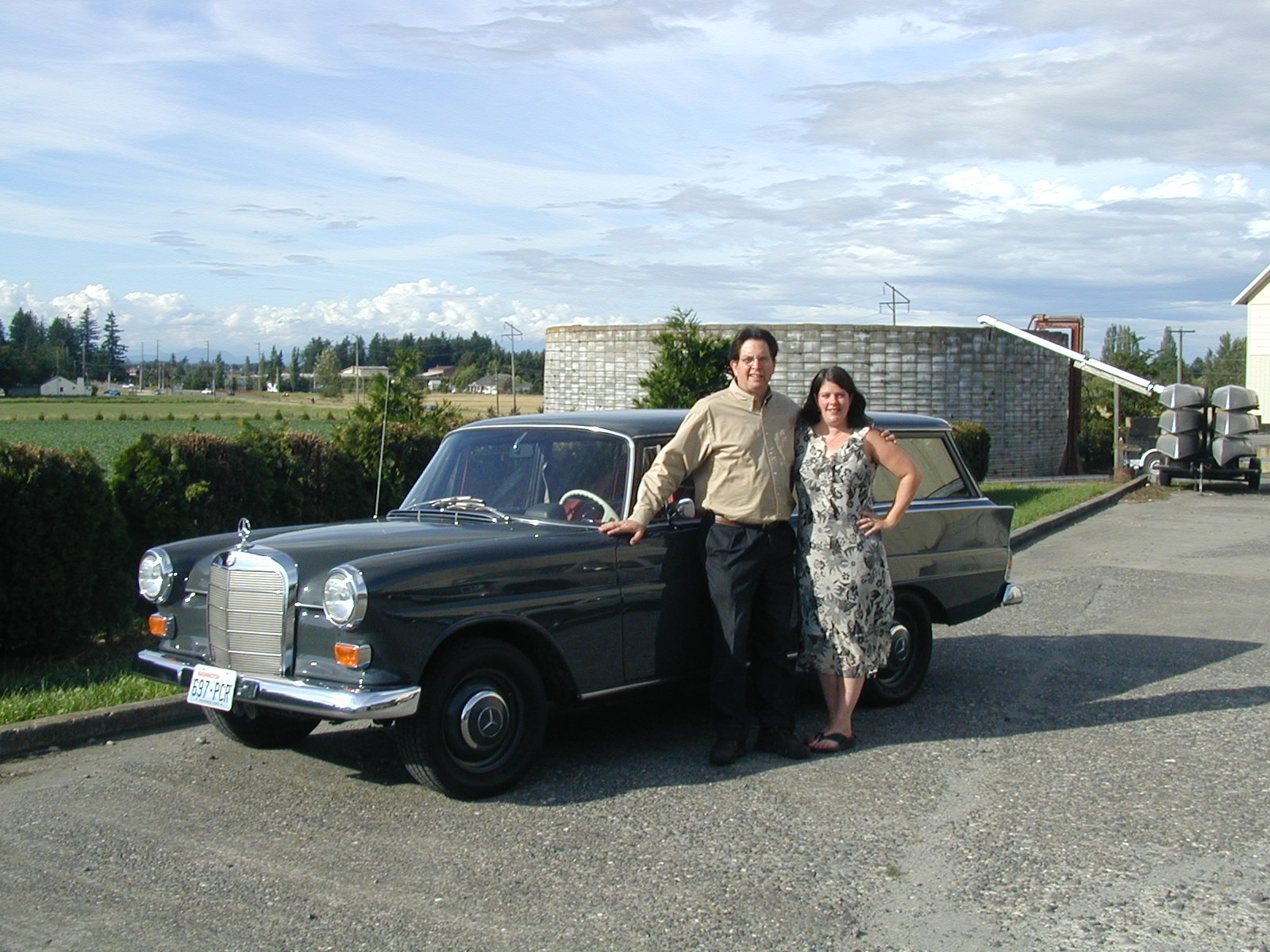
For over 10 years our business was located on a converted 40 acre dairy farm in Bellingham, WA. 90 miles directly north of Seattle and about 20 miles to the Canadian Border. In August of 2007 moved to a new commercial building in an industrial complex to focus more on our internet business.
In the 40 plus years that I have been both an automotive and aircraft mechanic, and a pilot I have worked on just about everything. It was about 10 years ago a friend convinced me to buy a Mercedes Benz. It didn't take me long to find a new passion and in a very short time this obsession became a business.

Bergsma Motorwerks was started to provide a much needed service in our area to maintain, repair, and refurbish Mercedes Benz automobiles. In the past twelve years we have restored/refurbished over 150 Mercedes as well as servicing and repairing many more. We have become intimately familiar with every model from the mid 1950's 220s to the early 1990's W124s. During this time our specialties included cost effective rust repair, damage repair, sheet metal replacement, interior repair and upgrade, and body and paint as well as engine overhaul and used engine transplants, transmission replacements, suspension, brakes and performance tuning.
With the rapid growth of the Internet in the late 1990's it became apparent to us there was a much bigger need for helping owners repair their own Benz. We started to fill this need by selling new and used Mercedes parts on the Internet. Soon came repair and installation instructions packaged with the part and written specifically for the do-it-yourselfer.
That was followed with more detailed repair manuals to aid in repairing the more common problems faced by most owners. More recently we have added Diagnostic Guides that will help you diagnose the problem before you spend money on expensive parts. And currently, we are working on downloadable PDF book files that our customers can purchase and obtain immediately. Most of these files will be related to emergency type repairs where you need the information fast.
In the years to come we will continue to add to our selection of Mercedes repair kits with instructions, repair manuals, upgrades, biodiesel and SVO / WVO products, diagnostic guides and downloads, and quality new and used parts. Our goal is to be the number one source on the Internet for those who want affordable parts and easy to understand repair information when confronted with the challenge of doing-it-themselves!
Kaia (on left) and Kristen are ready to assist you. If you are new to our website you will love our customer service. Try us out! We believe in helping people and in having fun at the same time.
Kiana is hard at work formatting a new set of instructions. She has mastered In Design and Aperature. She also takes care of all the parts postings to the website. Note the importance of the letter K around here. We are not sure how that happened!
FEBRUARY 2008 UPDATE: Kent is working hard to finish his new advanced D.I.Y. mechanic series of manuals. Last month he actually fell asleep sitting at the computer. To read more about these new manuals CLICK HERE.
We hope you enjoy our website and our products. Thanks for visiting, Kent and Kaia Bergsma
P.S. Now for a little real old history.
Kent, Linda and Kaia in the highlands of New Guinea in 1977
For a little more history here is a picture that was taken 30 years ago. That is Kent holding young Kaia beside his wife Linda. Taken in the highlands of Irian Jaya, Indonesia (formerly Dutch New Guinea) where we lived and worked among the most primitive people in the world. In the background you will spot Kent's trusty Cessna 206 that brought him home safely on many occasions. We will be posting more pictures and stories of their adventures in the months to come right here at mercedessource.
Kent is currently writing a book titled "Flying the Land that Time Forgot: A Bush Pilot's Tales of Life and Survival in a Distant Stone Age Land." If you are interested in learning more just drop us an email.
From the Land That Time Forgot (Irian Jaya)
If you like suspense you might enjoying reading some excerpts from the chapter titled Nine Lives.
INTRODUCTION : People often ask me why I dont fly airplanes anymore. I find it a little hard to explain, especially to those who have never flown small airplanes in high risk environments. When I was young I could not figure out why many retired combat pilots did not want to talk about their flying experiences. Now I understand why. Recently the subject came up again when we were eating out with our kids at a local restaurant. I looked over at my youngest son and asked him if he knew why I did not fly. Without hesitation he promptly replied. " Dad, you are like a cat with nine lives. Only problem is you have used them all up." I was surprised by his answer. I thought this was a very astute reply for a young man. As I though about what he said it gave me the idea for a chapter in my book.
The next day I sat down and starting outlining how many really "close calls" I had during my bush flying career. To my amazement I realized there were nine of them. In every one of the them the margin between life and death was very very small. Coincidence or a serious warning? Read on and I will let you decide.
Typical mountain landing strip
This is the story of my first harrowing flight incident that occurred in the highlands of Irian Jaya, Indonesia. It happened when Linda and I had only been in the country for four months and I had only a few weeks of flying under my belt. This particular incident taught me a very valuable lesson that served me well for the next eight years. At the time this happened we were living on a 4000 foot plateau in the central highlands. The airstrip outpost was approximately 150 miles south and west of our main base, Sentani, which was located on the central northern coast of the Island. Sentani, formerly known as Hollandia, was the hub of our flight operations in Irian Jaya. All cargo, supplies and inbound passengers first came to through Sentani to make connecting flights into one of the many interior airstrips. Since there were no roads into the central highlands, everything and everyone had to be transported by aircraft. At least two to three times a week I would fly my Cessna out to Sentani to pick up passengers, cargo and supplies and fly them back into the interior.
A normal flight was approximately an hour and 10 minutes one way and took me over some of the most dense and un-populated jungle on the face of the earth. No pilot wanted to think too much about loosing an engine over those jungle swamps. They were full of poisonous snakes and crocodiles, and there were miles and miles of dense tree canopy that was over 200 feet above the ground. On numerous trips I can remember looking down and trying to decide, Ok, if I loose an engine, am I going to land in the trees and risk a 200 foot drop through the canopy to the jungle floor, or would I be better off landing in one of the winding rivers and battling it out with the snakes and crocodiles? Either option was not very pleasant to think about. In fact, I just stopped thinking about it and did my job flying the airplane.
Weather was a constant problem on all our flight routes and the weather in Irian was very unpredictable and very unforgiving. Changes occurred very rapidly and without warning. We had no weather forecasters and no doppler radar! All we had was a good eye, a chart and compass, and the seat of our pants! But I could always predict one thing. The later in the day the greater possibility of bad weather. In most tropical countries with mountainous terrain, the weather patterns can be somewhat predictable. The early mornings would start out with blue sky with some fog hanging around in the valleys. By 8 am the fog would burn off and you would experience beautiful calm weather. By 10 am the winds would start to pick up from heat rising up the mountain slopes and wisps of clouds would begin to form. By noon the clouds would be building rapidly and begin affecting my flight paths. By 2 pm the entire region would become grey and ominous with light rain falling in some areas. By 4 pm the sky would open up and the highlands would close down with severe rains and thunderstorms that would continue into the late evening hours. The next morning it would be clear and the cycle would be repeated. When it did rain it really rained. This pattern would often produce over 200 inches a rainfall a year! These weather patterns always affected my flight planning and determined most my scheduling. The goal was always to complete the schedule and to be back to my home mountain base by 3 o clock in the afternoon.
One day I was running a little behind schedule when I landed at Sentani to pick up another load to fly to the interior. It was past 2 oclock in the afternoon so I decided to quickly get the airplane loaded. As I looked in towards the mountains I could see the weather was starting to build rapidly. I knew if I did not get airborne quickly, there would be a good chance I would not be able to make it home. If the weather closed down enroute, I would have no choice but to turn around and come back to Sentani for the night. I loaded the plane with haste, jumped in, and started cranking the engine. As the engine turned over, I heard a noise that didnt sound quite right. It was very faint and sounded a little like an exhaust leak. The engine fired right up and idled smoothly. I sat there for a few seconds and analyzed my engine instruments. Everything looked and felt normal. Could that strange sound just have been my imagination? Since the engine seemed to be running fine, I decided to take off and high tail it for home. What I did in those few seconds was to fall prey to a disease that we pilots call Get-home-itus. Even though my gut was telling me something wasnt quite right, the strong urge to get home overpowered my better judgement. I rationalized away my concern by telling myself, Oh, everything is going to be o.k., it is just a minor problem I can look into later. Unfortunately, this same scenario which I had been warned about has killed many a pilot over the years. But it did not stop me this time. I called the tower, taxied to the end of the airstrip, applied power, did a straight out departure and headed for the mountains. The only thing on my mind at that point was to try to beat the weather. Ten minutes after take off I called Bokindini and notified them that I had departed Sentani and was in-route and that my ETA (estimated time of arrival) would be approximately one hour. I climbed up, and leveled off at 9,000 feet. It was a little bit of a bumpy ride, and I could see up ahead that I was just going to have to skirt around a few thunder storms. The interior reported light rain was beginning to fall but the valleys were still open.
Fifty minutes after departure I cleared the lowland jungles and started up the long narrow valley leading towards our highland base. I was maintaining my altitude at 9,000, the weather up ahead appeared to be holding and everything seemed just fine. On the flight inbound I had been monitoring my engine instruments. The cylinder head temperatures, oil pressure, oil temperature and fuel flow were all functioning within normal limits. I was just getting ready to pick up the microphone to give a position report when all of a sudden all hell broke loose in the engine compartment. There was a loud explosion followed by a terrible banging noise. It quickly became obvious to me that something was repeatedly hitting the cowling of the engine. I quickly looked down at my engine instruments to try to pick up any clues as to what was happening while pulling the power back to reduce the noise. I couldnt figure out what had happened, but I knew it had to be ugly and I was probably going to have to land whether I wanted to or not. I was 20 minutes out of Bokindini and knew there was no way I could get home on reduced power. And then it struck me, I remembered that on previous training flights, there was a remote abandoned airstrip somewhere in the valley I was flying over. I quickly looked around to the left and right side and up ahead straining to locate this airstrip. Finally, I rolled the plane up into a steep bank and directly underneath me was the abandoned strip, Kobakma! I could not believe my good fortune or maybe it was something more than good fortune. I decided to keep the engine running for the time being even though It was still banging and clanging, but I was keeping a close eye on the oil pressure gauge. I knew I should get onto the ground as quickly as possible and started a spiraling decent right over the airstrip. Within a few seconds of starting the decent I began to smell gasoline fumes. That is when I became very concerned, in fact, down right scared. For a seasoned pilot here is nothing worse than the fear of in-flight fire. Planes can glide just fine without engine power, but they dont fly long when they are on fire! I reached for the microphone, clicked the button, and was just started to say, May-day, may-day!, when I stopped. I thought, No, I cant do that. I knew my wife Linda was standing by the radio at Bokindini and if I came on with a frantic may-day, that would freak her out as well as everyone else on the island listening on the open radio channel. So instead I casually said, Bokindini, Bokindini, this is Mike-Charlie-Kilo. I am experiencing engine mechanical problems and will be landing at Kobakma in a few minutes. Will report, once on the ground. I immediately turned the radio off because I did not want to be distracted by incoming radio traffic. I pulled the power all the way back, slowed the plane up, pulled on 20 degrees of flaps, and put the plane into a steep banking spiral to increase my rate of decent without buiiding up too much airspeed.
Landing Kobakma without an engine
I was becoming increasingly concerned with the strong smell of gasoline that was entering the cockpit. I knew I had to shut the fuel off but wanted to be sure I could make it to the strip. With the engine shut off there would be no room for any error in the approach. So I kept the spiral tight and directly above the airstrip to prevent any chance of overshooting the runway and landing in the jungle. When I was sure I had the field made, I reached over, pulled the mixture and turned the fuel selector valve off to shut the engine down and stop the fuel flow. I banked onto final approach at 85 mph and made a fast, steep descent to the end of the airstrip. I tagged that Cessna 185 right on the end of the airstrip and rolled quickly up slope to the top end, applying heavy breaking as the prop just stopped dead, right in front of my nose. As the plane responded to the braking and slowed down I knew I had made it and began to breath again! With the last bit of momentum the plane quietly rolled to the top of the airstrip. I spun it around 180 degrees and stopped dead. I can still remember sitting there for a moment just trying to catch my breath and pondering what had just happened.
This all transpired so quickly. When it was happening it seemed like the whole incident took forever, but from the time the engine blew to the time that I was on the ground less than 5 minutes had passed. I remember sitting there a little dazed and thinking to myself, Boy that was exciting. I did not realize just how dangerous the whole situation was until I opened the door and stepped outside the airplane. I turned around and I could not believe what I saw. The entire belly, sides, and tail of the airplane were covered with engine oil! It looked as if somebody had tried to paint the plane with a big brush and a bucket of used engine oil.
Very quickly the local natives started to surround the airplane. From all the commotion I figured they knew something was wrong, I know they had not seen an airplane with this kind of gooey substance all over it before. They were chanting and clicking their gourds with excitement. I decided that I had better call in before people started worrying about me. I think the whole island was holding their breath because I had gone off of the radio and did not call back for those few silent minutes. I quickly turned the key back on, fired up the radio and called Bokondin and said, This is Mike-Charlie-Kilo, calling in to report I am safely on the ground at Kobakma with a dead engine. I will be doing an inspection of the damage and will get back to you soon. I looked at my watch and realized it after 4 pm. It was getting late enough in the day that I knew nobody was going to be able to come and get me. I knew I was looking at an overnight stay in the middle of the jungle.
I pulled my trusty tool kit out from under my seat, grabbed the screwdriver and decided I should probably go ahead and open up the top cowling section of the engine. I was dying to see what had actually happened and to survey the extent of the damage. When I loosened up those screws and lifted the cowling off, in a moment I really realized how fortunate I was. I was standing there looking with amazement at a damaged cylinder head. The head had separated completely from the cylinder barrel! The failure was so violent that it had torn the fuel injector line loose and cracked open the exhaust manifold. The engine had been spraying raw fuel all over the hot cylinder head open exhaust manifold. It took a few moments for all of this to sink in, but when it did, I realized that the outcome of this incident could so easily have been fatal. Not only was it a miracle that the engine did not catch on fire, it was a miracle that it happened right over the top of an airstrip. If this would have happened 10 minutes earlier or 10 minutes later I would have been crashing into the jungle. 10 minutes earlier I would have been going into the swamp with those crocodiles and snakes I told you about. 10 minutes later I would have had to put the plane down into high mountain terrain. Not only had the cylinder head severed from the barrel, but the engine had pumped out almost seven quarts of oil and that engine only held eight quarts total! So, no way was I going to be staying in the air any longer than a few more minutes. I fired up the radio again and called the main base and explained the situation and my thoughts on getting me and the plane safely out of there. I figured I could repair the engine on site if someone could arrange to fly in the needed parts. I was going to need a complete new cylinder assembly, exhaust manifold assembly, fuel injection lines, wires, gaskets, etc.
Spending the night in the local village
Since I was going to have to spend the night in the native village, I prepared my self by grabbing my mosquito net and other survival equipment out of the back of the airplane. I buttoned up the aircraft and headed off with the chief to their village high above the airstrip. I could not speak much of the local dialect, but it was obvious they were excited to have such a special visitor. They killed the fatted chicken and prepared a small feast in my honor. After dinner I retired to a small round hut provided by my hosts. Sure good thing I carried that mosquito net in my plane. It was a very restless night. Not only was I sleeping on a hard bark floor with no mattress, but as I lay I found it hard to get to sleep as I pondered what could have happened. This incident could have had a number of different endings which all could have been disasterous. I thought long and hard about what I should learn from it and how I could avoid a repeat in the future. I knew the airplane was trying to talk to me back there on the ramp when I cranked it up. I didnt listen. The moral of the story was - if you hear a strange noise and something doesnt seem right, then check it out before taking off. Do not ignore it. I also determined to never fall prey to get-home-itus again. And I instigated a more aggressive engine inspection program. The lessons I learned on that fateful day served me well and played a key role in keeping me safe.
During the remainder of my flying experience, there were a few other times when I knew things were not quite right and I stopped and I made sure they were right before I took off. Like with many mistakes or accidents in life, airplane accidents are usually a result of a multiple chain of events or decisions that are progressively linked to each other. Airplanes can be very unforgiving. If you are going to fly in bush conditions you must understand this principle to be a safe pilot. You must be vigilant at all times and when you sense something is not right you must break the chain or you can kill yourself. In the incident I just described the chain could have been broken if I would have said to myself, back in Sentani, Ok, this doesnt sound right. I need to shut this engine down and get out, open up the engine and see what is going on. Upon close inspection of the engine immediately after this incident, I found severe exhaust and oil staining around the cylinder barrel. This indicated a compression leak between the cylinder head and the barrel. I would have seen this if I would have taken the cowling off and looked things over. This evidence would have shown me something was not right with number 2 cylinder and all I needed to determine this was my eyes!
Because of this experience, I made a decision that I would start a new inspection procedure that was not required or even recommended. I called it my 25 hour visual engine inspection and used in successfully for the rest of my flying career. With commercial aircraft we were required to perform a complete airframe and engine inspection every 100 hours the plane flew. This required opening up key inspection covers on the airframe and removing the engine cowling and then going through a check list to look for potential problems. I discovered a lot can happen to the engine in 100 hours. My last inspection did not pick up the cylinder head problem. The looseness of the cylinder head and the consequent failure probably happened in 20 hours of flying, not 100. I immediately started a procedure where every 25 hours of flight time I would completely remove the cowling off and give the engine a thorough visual inspection. This usually only took me 30 minutes, but I recall there were at least another 8 to 12 instances when this inspection picked up little problems that if not attended to could have developed into a severe problems or potential engine failure.
What happened on that day never happened to me again. Other things did happen as you will learn in the following pages, but I did not have another incident that was related to strange airplane noises (plane speak) or get-home-itus. This may be a good case for believing there is a reason for everything that happens in your life. The important thing is we can all learn from these lessons to prevent the problems from occurring again.
The second really close call happened within a few months of the first. My inexperience and lack of good judgement could literally have been the death of me. As with the first incident, the lessons I learned were also burned deep into my consciousness and helped keep me alive in the years that followed. I learned a good hard lesson about saying no and a huge lesson about fuel management. There is an old saying among bush pilots, The only time you have too much fuel on board is when the plane is on fire. I think after you read this story, you will see why I became a firm believer in this adage. Before I get started in the details of the incident, let me share with you a little background.
As a pilot in training you are taught early on how to properly manage your aircrafts fuel supply. When you are in the air you just not able to pull off to the side on short notice, pick a service station and fill it up. Flying an airplane requires you to plan not only for the amount of fuel you will need for your flight but also for the potential of the unexpected. You never just carry enough fuel to get to your destination and back. Any pilot will tell you that it is the unexpected that can get you in trouble, and running out of fuel can be very embarrassing and sometimes fatal. As a bush pilot I was taught to always carry an extra hour of flying time in the fuel tanks. That may seem like a lot of time but when you are flying over the jungle you don not have any roads to set down on should you run low on fuel. To be continued .........